How to jump rope in an apartment (quietly)
Most of the noise is your landings, not the rope. Technique, a mat and the right time of day solve most of it.
Key points
- Land on the balls of your feet and hop low.
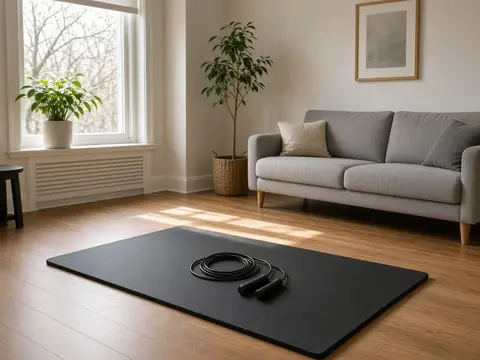
- A thick mat on a rug cuts both thuds and rope slap.
- Check ceiling height with a slow test swing first.
You can skip indoors without a war with the downstairs neighbours. The noise is mostly the thud of landings, not the rope, so quiet technique and a good mat do most of the work.
Space check
- Ceiling: the top of the rope's arc is roughly 30 cm above your head. Hold the rope by your sides and swing it slowly once to test before you start.
- Floor area: about 1 metre clear on each side and in front and behind.
- Hazards: light fittings, shelves, pets, glass coffee tables.
Cut the noise
| Fix | Effect |
|---|---|
| Land on the balls of the feet, heels hovering | Biggest single difference: no heel thuds |
| Hop lower (2–3 cm) | Less force per landing |
| Thick rubber or foam jump mat, ideally on a rug | Absorbs impact and protects the rope |
| Cushioned shoes | Softer landings than bare feet on a hard floor |
| Alternate step instead of two-foot bounce | Lighter, rhythmic landings |
| Beaded or PVC rope on a mat | Rope slap is quieter than on bare tile |
Be a good neighbour
- Avoid early mornings and late evenings.
- Ask the people below whether they can hear it. Many will not mind a 10-minute session at a predictable time.
- Ground floor, garage or balcony (if allowed and safe) are easier options.
When you really cannot jump
Ropeless training handles (short weighted tails, no rope) let you practise the arm motion and footwork without the rope hitting anything. A ropeless "skip" without leaving the floor (rapid heel raises with a rhythm) is quieter still. Neither trains the timing of a real rope, so mix in real skipping when you can.
See also surfaces and shoes and the 10-minute workouts.